Naming Workbench
People stop misreading data when everyone uses the same words for it. The Workbench lets you agree each business term once, enforces it as your naming standard, and links it to every field, program and document that uses it.
Fewer misunderstandings, faster decisions.Business, IT, compliance and audit read the same term the same way, because there is one agreed definition for each.
Standards that hold, without policing.New names conform from day one, because the Workbench checks them against your rules and rejects those that break them, with the reason.
Your systems become readable to everyone.Cryptic field names gain plain business names, because every field is linked to the agreed term it holds.
How it fits
The Workbench sits between the systems you already run and the people and tools that need to understand them. Mainframe and distributed systems feed in; agreed names flow out to developers, catalogues, documentation and AI.
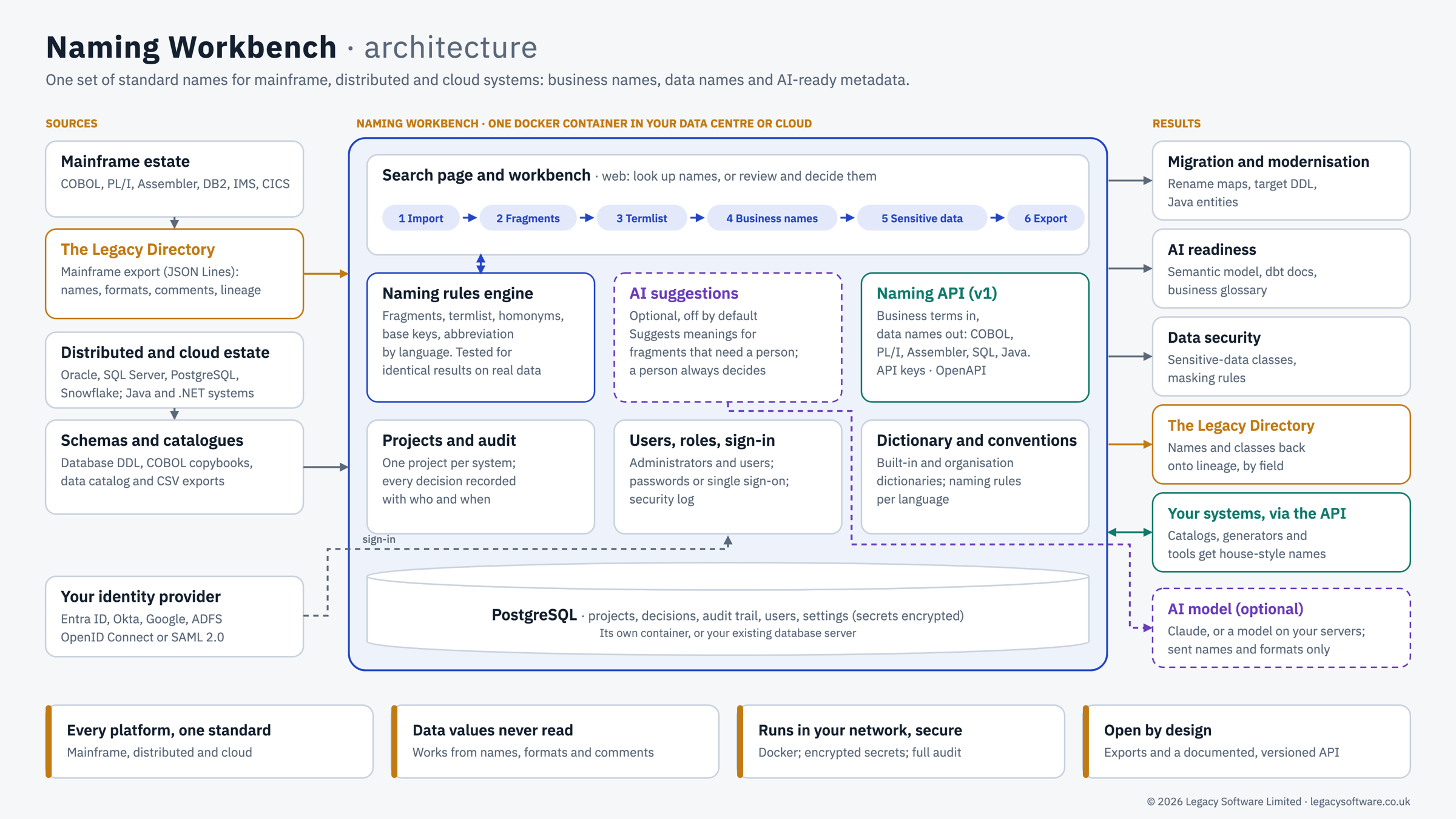
Your whole estate is covered, because names are taken from The Legacy Directory's source-to-target lineage, mainframe copybooks and tables, and distributed and cloud databases alike.
Each meaning is settled only once, because rules decide the clear cases, AI can suggest the rest, and your experts approve.
Agreed names reach every team, because the search page, the naming API and standard exports deliver them to the tools people already use.
Documented and understood
Documentation is only useful if people can read it. The Workbench turns field names like L01B-OP-DATE into "Opening Date", so your system documentation speaks the language of the business.
A corporate vocabulary, simply
You don't start with a blank page. Your existing systems already contain most of your vocabulary; the Workbench finds it, standardises it and links it back.
Your naming conventions, the CLASS and PRIME words that structure each name, the order of prefixes and suffixes, and which rules apply to data items, programs, files or screens: all are set by your administrators with tick boxes, not code.
Company-wide
The vocabulary describes your business, not just your code. Once it exists, the whole organisation can use it.
Because card data, credentials and personal data are classified from their names, you can list every place they are held without reading a single data value.
Because every name records whether a rule, an AI suggestion or a named expert produced it, and every override of the corporate standard is logged.
Because the search page needs no training and, if you choose, no sign-in, staff across the organisation can check the agreed name for themselves.
Because the glossary and results export straight to your data catalogue and to The Legacy Directory, every tool shows the same names.
Because sensitive fields are already identified, masking rules are exported ready for your test-data and loss-prevention tools.
Because rename maps, database definitions, Java classes and semantic models are generated from approved names, new systems and AI tools inherit your meaning.
Only in the Workbench
Names are right where generic tools guess, because you can give an abbreviation its own meaning in any part of a system: a whole layer, one program, a single COBOL group, a DB2 schema or table, or one data item.
Explainable
You can defend every name to an auditor, because each one is traced to the rule, AI suggestion or expert that produced it.
Practicalities
Your security and procurement teams can say yes quickly.
Because the Workbench runs on your own server or cloud account, field names never leave your control.
Because it signs people in through your existing identity provider, using OpenID Connect or SAML, when you turn it on.
Because a documented naming API returns the standard name for any business term, tools and scripts can check names automatically.
Because it is licensed by named seat, and anyone can use the search page without one.
See your own field names turned into one agreed vocabulary, in a demo on a system like yours.
Book a demo